Using the Rule of 55 to Retire Early

The “Rule of 55” is a useful tool for early retirement. However, retiring early is a relatively new concept, so the mechanics of withdrawing funds from retirement accounts can be a little complex. If you know the rules and exceptions, you can easily patch together a penalty-free withdrawal strategy to fund your retirement.
We want to preface by saying the starting point isn’t access to your retirement accounts; it’s what you want retirement to look like. This is why going through a comprehensive review like our COLLAB™ Financial Planning Process is a must. You want to uncover your deeper “why” and design your ideal retirement lifestyle before ironing out the nuanced details.
Table of Contents
What Is the Rule of 55?
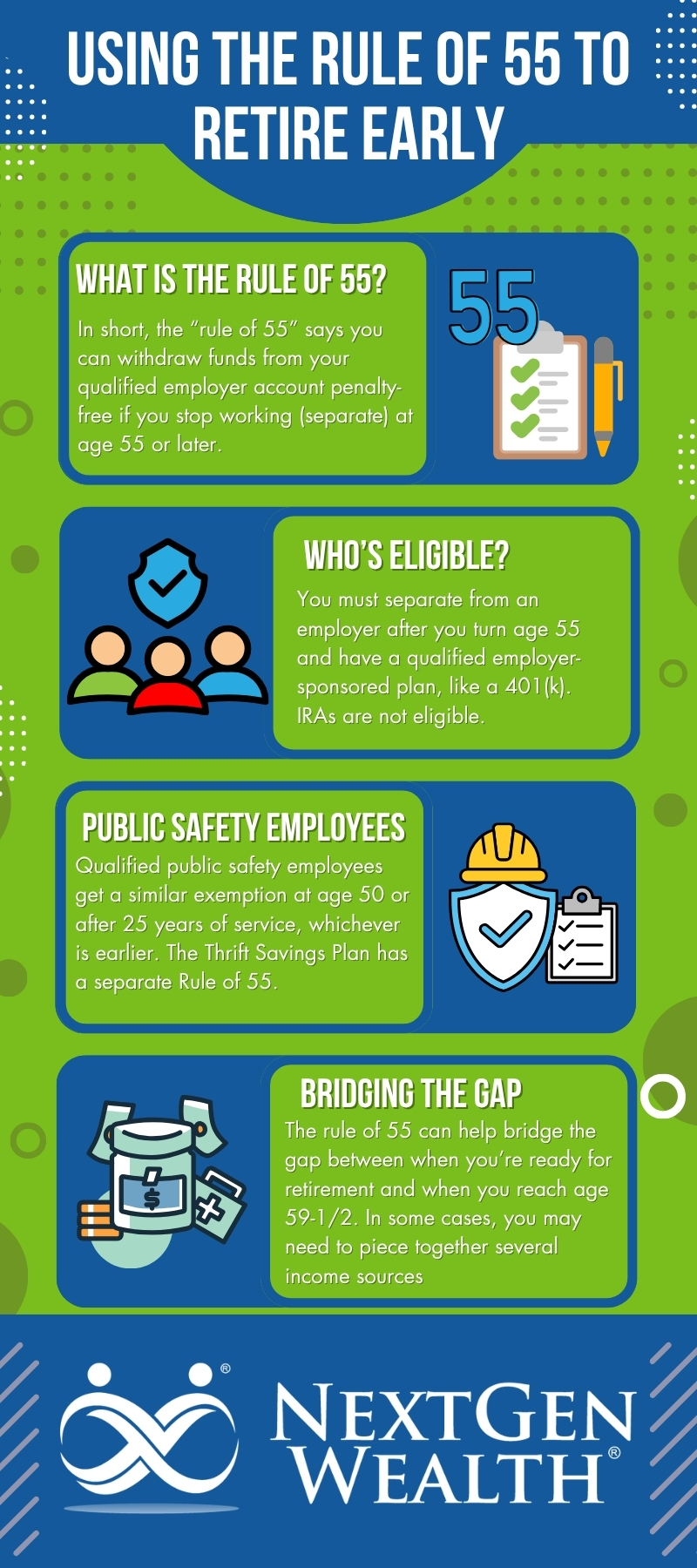
In short, the “rule of 55” says you can withdraw funds from your employer account penalty-free if you stop working (separate) at age 55 or later. This would allow you to access your 401(k) or other qualified employer plan up to 4.5 years earlier than the standard 59.5 age requirement.
Qualified public safety employees get a similar exemption at age 50 or after 25 years of service, whichever is earlier. And because the IRS likes to be confusing, this specific exemption for public safety employees doesn’t technically apply to the Federal Thrift Savings Plan (TSP). However, the TSP has a similar rule of 55 (under a different statute).
Avoiding the 10% Penalty and Understanding the Taxes
The main benefit of the rule of 55 is that it allows you to access your retirement assets sooner without the usual 10% early withdrawal penalty. The purpose of the penalty is to get people to leave their money invested for retirement. However, retirement looks different for everyone.
If you’ve saved everything you need by age 50 or 55, then it might not make sense to wait until age 59-1/2 to retire. Using the rule of 55 can let you access funds early and get started on the hard work of defining your purpose and your sense of fulfillment in retirement.
You still have to pay taxes on withdrawals, but this might actually be better in the long term. Since you’ll be withdrawing funds earlier, you’ll likely reduce your required minimum distributions (RMDs) and give yourself lots of time to implement tax-saving strategies.
Separate in or After the Year You Turn 55
It’s critical to ensure you meet the criteria of being age 55 and separating from an employer plan. In other words, if you have a 401(k) or TSP, and you’re age 55, you should meet the criteria. The exemption only applies to your current employer plan.
This is why your current employer plan matters the most. If all your money is tied up in another plan from a previous employer, you won’t meet the criteria. Most plans allow you to roll money in, so you may want to do that sooner rather than later.
Bridging the Early Retirement Gap
The rule of 55 can help bridge the gap between when you’re ready for retirement and when you reach age 59-1/2. In some cases, you may need to piece together several income sources to ensure your income needs are covered. In most cases, you may need to coordinate 401(k) withdrawals, cash on hand, taxable accounts, and Roth accounts.
You may want to leave a portion of your balance in your employer retirement account and then roll the rest to your IRA. This allows you to work with a financial planner to manage your IRA while still keeping the ability to withdraw using the rule of 55.
You might also be able to use this type of partial rollover to take substantially equal periodic payments (SEPPs), also known as 72(t) withdrawals. This is another handy exception for early retirees.
Common Rule of 55 Mistakes to Avoid
If you’re going to use the “rule of 55” to fund your early retirement, then you need to be aware of some common mistakes. If you plan accordingly, you should be in good shape.
Rolling Your 401(k) Into an IRA Too Soon
Many retirees are ready to roll their 401k over to an IRA as soon as they quit working. However, you don’t want to do this until you know if you’re going to need to use the rule of 55. In most cases, you only need to leave enough to cover what you expect to withdraw.
Make sure you account for market fluctuations and inflation in your spending numbers. You want to meet your needs without cutting yourself short.
Assuming Your 401(k) Plan Allows Flexible Withdrawals
Not all retirement plan administrators are created equal. If you’re going to have trouble getting your money distributed to you, you may need to explore other options. However, most modern 401 (k) providers offer several withdrawal options.
Forgetting About Federal and State Income Taxes
Don’t forget, your tax-deferred, “traditional” 401k will be taxed as ordinary income. You’ll need to account for federal and state tax withholding or have other cash on hand to cover the taxes. Even if you employ other tax-saving strategies, you’ll still need to factor in taxes.
Using the Rule of 55 Without a Broader Income Plan
You want to consider early withdrawals in the context of your overall financial plan. In other words, start with the big picture and what will make you happy, then work from there. Just because using “the rule of 55” or a “72(t) withdrawal” sounds cool, doesn’t mean it’s best for you.
We suggest engaging with, or building, your retirement team to get a clear picture of your needs. Uncover your goals and deeper “why” in retirement, then select the right tools and strategies to get you there.
Tax Planning Considerations Before Using the Rule of 55
Tax law is the main reason retiring early becomes complicated. The IRS doesn’t really like non-standard anything – including your retirement date. Most laws and systems are designed around the age of 60 or 65 for retirement.
In reality, you can pick any age to retire. You can also keep working in a different capacity. It’s up to you to decide what your retirement life looks like.
Estimate Your Retirement Tax Situation
A lot of folks have a hard time understanding tax law – including the pros. There are always new nuances and rules to keep track of. Plus, tax law changes all the time with SECURE 2.0, the One Big Beautiful Bill Act, and other legislation; it can be impossible to predict what your tax bracket or estimated tax bill will be.
However, you can use current law to determine your “best guess” of what your tax bill might be. Life happens; taxes follow. Even a rough guess will help make sure you’re in the ballpark to be covered for taxes.
Watch the Impact on Roth Conversions
If you were planning to do Roth conversions, be mindful of the impact of withdrawing for income. Both Roth conversions and regular withdrawals for living expenses increase your taxable income. The idea is to convert, if necessary, in the most efficient way possible.
Plan for Health Insurance Before Medicare
There’s been a mix of opinions and speculation around the end of the enhanced Affordable Care Act (ACA) Premium Tax Credits (PTC). Healthcare is an expense we all have to tackle in one way or another. Retirees spend a significant amount of money on medical premiums and other costs.
You’ll need to plan for medical expenses not only for the costs, but to meet the minimum income needed (100% of Federal Poverty Guidelines (FPG)) to qualify for the PTC, while hopefully not exceeding 400% of FPG and getting phased out of the PTC completely.
Coordinate with Pension, Social Security, and Investment Income
You’ll also want to project your income from pensions, Social Security Disability Insurance (SSDI) payments (if applicable), and investment income, such as interest, dividends, and passive income. All of these can offset your need for additional income and increase your taxable income. Make sure you’ve got a clear picture of all your retirement income streams.
Example: Using the Rule of 55 as an Early Retirement Bridge
Let’s assume our pal Max Benny and his wife Minny decide to retire early. They’re hard-working savers, and both have significant 401(k) balances. Max sees the writing on the wall: artificial intelligence (AI) replacing much of what he does at work.
He decides to plan his early retirement on his own terms. There’s only one problem: he’s 56, and Minny was forced to “retire” early due to health complications at age 54. They’ve got to figure out how to pay for their living expenses until they can access their money penalty-free and/or draw Social Security.
Age 55 to 59½: Drawing From the 401(k)
Max runs the numbers and figures they’ll need about $7,000 per month to pay for medical insurance and living expenses. They had an effective tax rate last year of about 12%, and their state tax rate is about 5%.
Max and Minny like to be very conservative with their estimates, so they add for inflation and market fluctuations. With help from their accountant and financial planner, they determine they’ll need to withdraw roughly $98,280, or $8,190 per month, for the first year.
Next, Max adds 3.4% inflation for the next three years and 13.46% for market fluctuations based on historical 60/40 portfolio volatility studies. They’ll need roughly $469,302 to fund the Benny household for the next four years. Max plans to leave what he needs in his 401(k) and then transfer the rest to his IRA with his financial planner for investment management.
Age 59½ to 65: Adding More Flexibility
While Max and Minny use the rule of 55 to withdraw from and live off his 401(k), their other investments have continued to grow. Once Max and Minny turn 59-1/2, they now have more flexibility. They can easily tap into additional retirement funds as they approach Social Security eligibility.
Age 65 and Beyond: Medicare, Social Security, and Long-Term Income Planning
Once Max and Minny reach age 65, things get even easier. They’re eligible for Medicare enrollment, nearing full Social Security retirement age, and they have even paid off their house. More importantly, Max and Minny have truly enjoyed the past decade of retirement together.
Note: This is a hypothetical scenario based on historical data and fictional characters. Please consult with a fiduciary financial planner or other financial professional for your specific situation.
Final Thoughts: The Rule of 55 Is a Tool, Not a Retirement Plan
Just because you can do something doesn’t necessarily mean you should. There may be other income options or better uses for your employer-sponsored retirement accounts. However, it’s good to know what options are available.
Use the Rule Strategically, Not Reactively
Know the rules and create a plan before you quit. It’s always best to consider all your options before implementing. You don’t want to just “wing it” or make a knee-jerk decision when it comes to tax rules and having a secure income.
Bottom line, you should build a retirement income plan before making the leap.

 This article was written by