Updated: Preparing Retirees for the TCJA Sunset
This post was last updated on March 30, 2026, to reflect all updated information and best serve your needs.
The Tax Cuts and Jobs Act (TCJA) of 2017 significantly changed our tax landscape. Most changes were temporary and set to expire or “sunset” at the end of 2025. However, this didn’t exactly happen.
This article was initially published in late 2024. Because of changes to the law, most of the information in the original article became irrelevant. It was still important to leave this here as a historical context and help anyone searching for the TCJA sunset find the relevant information.
Key Takeaways and How to Use This Article
Here’s the main takeaway you need to know. Instead of letting TCJA expire, Congress enacted the One Big Beautiful Bill Act, which made much of TCJA permanent. There are some other provisions which affect retirees, like changes to Medicare and Social Security taxation.
For the rest of the article, we’ll leave it mostly intact and add a “One Big Beautiful Bill Act Changes to [insert topic]” section after each section or paragraph.
Table of Contents
- Understanding the Tax Cuts and Jobs Act
- Changes to Income Tax Brackets
- Maximizing Tax Benefits While You Still Can
- Potential Risks to Acting “Early” on TCJA
- Roth Conversions: Should You Act Now?
- Reevaluating Your Income Strategies
- Reviewing Your Estate Plan Before Tax Exemptions Change
- How The One Big Beautiful Bill Act Affected Estate and Gift Taxes
- Charitable Contributions and Gift Giving: Timing Giving for Maximum Impact
- Capital Gains Considerations Before the TCJA Expiration
- Required Minimum Distributions: Planning for Higher Tax Rates
- Higher Deductions for Age 65 and Older Instead
- Seeking Professional Guidance on Changing Tax Laws
Understanding the Tax Cuts and Jobs Act
The Tax Cuts and Jobs Act (TCJA) included many changes, but most were tied to income tax brackets, credits, and deductions. The number of marginal tax brackets and thresholds was overhauled, as were standard deductions. The estate and gift tax exemptions were also significantly increased.
What We Thought Might Happen in 2025
For a long time, we didn’t know exactly what would happen to the TCJA provisions, which were set to expire on December 31st, 2025. There was a lot of uncertainty due to significant shifts in the administration following the 2024 election. Many of the provisions from TCJA were set to revert to the former rules.
What Actually Happened: The One Big Beautiful Bill Act
What actually happened was a permanent extension of many TCJA changes. With a Republican majority in the House and Senate, the One Big Beautiful Bill Act passed pretty easily.
Hoping to retire in the next 5 years or less? Download our 3 Pillars of Successful Retirement Plans.
Changes to Income Tax Brackets
The tax code before the TCJA had seven income tax brackets ranging from 10% to 39.6%. In 2018, these were adjusted to a range of 10% to 37%, and the threshold for the highest bracket was raised. Without additional actions, the old tax brackets would have been reinstated with inflation adjustments.
How The One Big Beautiful Bill Act Affected Tax Brackets
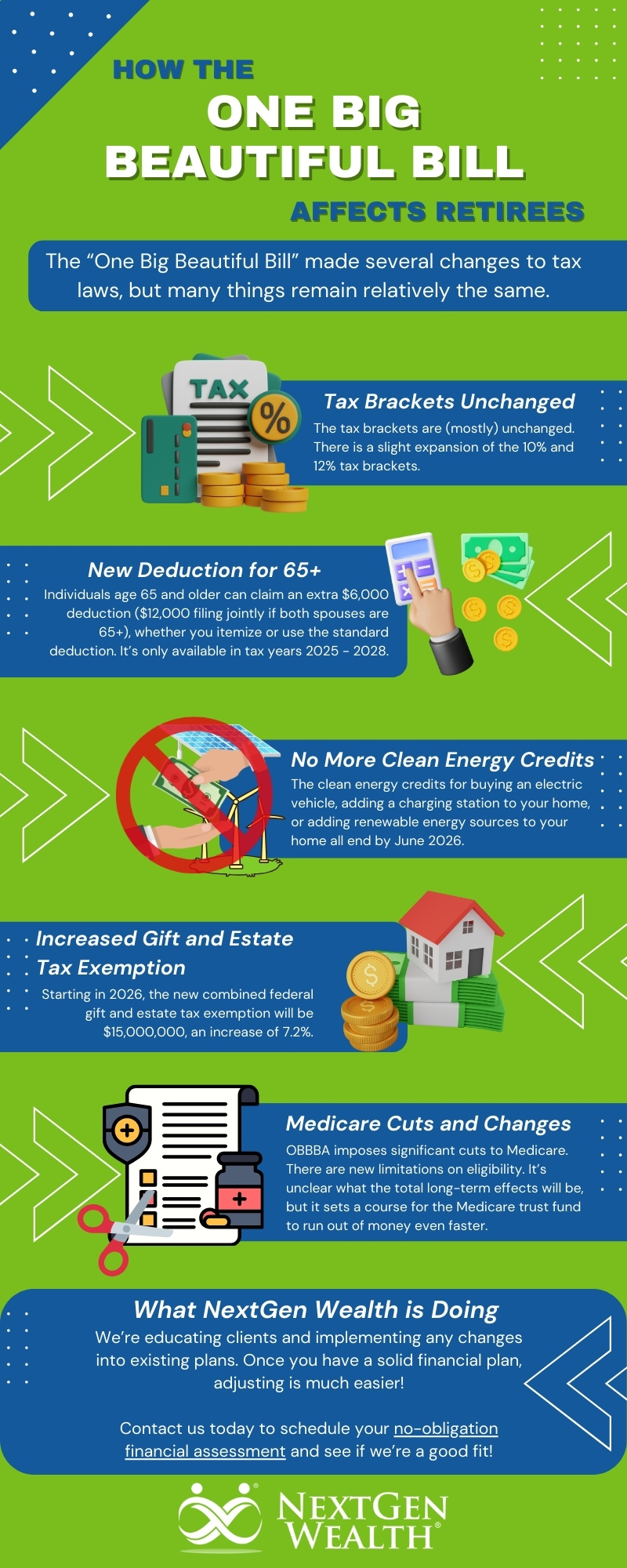
In reality, we now have tax brackets which look very similar to the TCJA brackets. There was a slight change to the inflation adjustments for the 10% and 12% tax brackets. In effect, this widened the lowest two tax brackets and made less income subject to higher tax brackets.
Cuts to the Standard Deduction
An often overlooked but significant change was the higher standard deduction. The TCJA eliminated personal exemptions and significantly increased the standard deduction. If TCJA had expired, then we would have reverted to lower standard deductions.
How The One Big Beautiful Bill Act Affected Standard Deductions
Since the sunset didn’t really occur, the current standard deductions were increased. In 2026, the standard deductions increased for inflation to $16,100 for single filers, $32,200 for married filing jointly, and $24,150 for head of household. Personal exemptions are permanently eliminated.
There's also an "enhanced" senior deduction of $6,000 per eligible taxpayer. This was designed to eliminate Social Security taxes for most seniors age 65 and older.
The Decision to Itemize
We’ll discuss this later in the article, but the higher standard deduction makes itemizing your deductions less appealing. You can still take other deductions for small business owners and for charitable giving without itemizing.
Changes to Deductions and Credits
Speaking of small businesses, another significant change would have been the removal of the deduction for Qualified Business Income (QBI). This could have significantly impacted some business owners.
How The One Big Beautiful Bill Act Affected QBI Deductions
Instead of the TCJA sunset, the new law made the QBI permanent, adjusted the phaseouts, and set parameters for annual inflation adjustments. Now, there's a minimum deduction of $400. The applicable phase-in for limitations is $75,000 (single filers) and $150,000 (married filing jointly).
Maximizing Tax Benefits While You Still Can
Before we knew the fate of the TCJA, we were trying to guess whether taxpayers' overall effective tax rate would be lower than in 2026. But most of the TCJA was extended.
Potential Risks to Acting “Early” on TCJA
We assumed both Republicans and Democrats were likely to keep things mostly the same for households with incomes under $400,000 annually—or at least this was what the former administration was using as a threshold. The TCJA was passed during the Republican “trifecta” majority in 2017, so we assumed they would keep much of it (if they acted in time).
In other words, there was a perceived minimal risk of acting now. And, more importantly, we recommended not worrying too much or getting stressed about it. We always recommend taking action based on the best current information and not speculating too much. If you want to stay current, join our newsletter for market information and news you’ll enjoy reading.
Roth Conversions: Should You Act Now?
Roth conversions have been a critical strategy since the introduction of required minimum distributions (RMDs). We regularly evaluate and analyze whether Roth conversions make sense for our clients. In short, Roth conversions let you pay taxes now and enjoy tax-free growth later.
There may be specific times when Roth conversions could make even more sense. Some common examples are the years after retirement, before drawing Social Security, and during down markets. In other words, your personal situation plays a much larger role in the timing of Roth conversions than anything.
Reevaluating Your Income Strategies
Many retirees have multiple streams of income. Not all income is created equal and will be affected differently by changes to tax law. For instance, your pension or Social Security income might not be affected as much as a large traditional 401(k) balance would be.
Reviewing Your Estate Plan Before Tax Exemptions Change
The TCJA had some significant estate-planning changes by increasing the federal combined estate and gift tax exemption. These amounts are adjusted for inflation annually. If TCJA had expired, the exemption would have dropped to roughly half its current level, but the OBBA raised it further.
Keep in mind, this is only for the federal side. Federal gift and estate tax law doesn’t change your state's estate tax limits. Regardless, you need to consider updating your estate plan and associated documents.
How The One Big Beautiful Bill Act Affected Estate and Gift Taxes
What actually happened was that the One Big Beautiful Bill Act set the federal gift and estate tax at $15,000,000 starting January 1st of 2026, and increases it for inflation every year after. Married couples now have a combined $30 million in gift or estate tax exemptions.
Charitable Contributions and Gift Giving: Timing Giving for Maximum Impact
If you’re charitably inclined, you want to ensure your money does the most good. Donating in a tax-efficient manner can help you achieve more of your goals. In this case, you might want to coordinate the timing of your charitable giving.
With the current higher standard deduction, strategies like bunching donations are more common. Since the standard deduction wasn't reduced, fewer people see a benefit from itemizing deductions. Therefore, you could donate larger contributions every other year to take advantage of itemizing your deductions.
Capital Gains Considerations Before the TCJA Expiration
There’s one area where there’s almost no change – long-term capital gains tax rates for individuals. We had anticipated there could be changes since short-term capital gains are taxed at your marginal tax rates. This short-term capital gains treatment can push you into a higher tax bracket.
We had recommended looking into tax gain harvesting or other strategies to realize capital gains before TCJA sunset. These are still good strategies to consider even without significant tax law changes.
Required Minimum Distributions: Planning for Higher Tax Rates
If you’re headed toward RMDs, then the TCJA sunset could have been a double whammy. If your tax rates go up and RMDs push you into a higher tax bracket, it could cause a mess.
Higher Deductions for Age 65 and Older Instead
What happened instead was an increase in the standard deduction and a new, temporary “enhanced senior credit” aimed at eliminating taxes on Social Security benefits. This additional $6,000 increase to your standard deductions could be a huge benefit.
Regardless, now is still the perfect time to explore tax-saving strategies and analyze how RMDs will affect you. A higher standard deduction doesn't change your RMD, but it does help with the taxes from your RMD.
Seeking Professional Guidance on Changing Tax Laws
At NextGen Wealth, we monitor current changes for our clients. More importantly, we conduct in-depth analysis and planning to ensure our clients don’t miss opportunities to maximize their retirement.
Contact us today to schedule your no-obligation financial assessment and see if we’re a good fit. Start planning your retirement and take action today!

 This article was written by