Direct Indexing for Retirees

There are so many different strategies for retirement. It can be overwhelming. Direct indexing is not for everyone, but for the right situation, it can be a real benefit.
Unfortunately, the more you make, the more taxes you pay. It might become one of your biggest concerns in retirement. However, not everything has to be complicated.
Table of Contents
What Is Direct Indexing?
In short, direct indexing is when your portfolio tracks or mimics a popular index like the S&P 500® or Dow Jones Industrial Average® (DJIA). To do this, you’d need to buy each stock individually. This means you’d need dozens or hundreds of individual stocks to have a portfolio to match the most popular indices.
The most common benefit of doing this is the ability to implement tax strategies such as tax-loss harvesting and tax-gain harvesting. These involve buying and selling stocks to lock in, or “realize” capital gains or losses. This means you’ll have slightly different holdings than the index you're tracking.
In other words, you’ll always have a little bit of “drift” as you buy and sell holdings. Your portfolio should still have similar returns, but it may be skewed one way or another.
How Direct Indexing Differs from Mutual Funds and ETFs
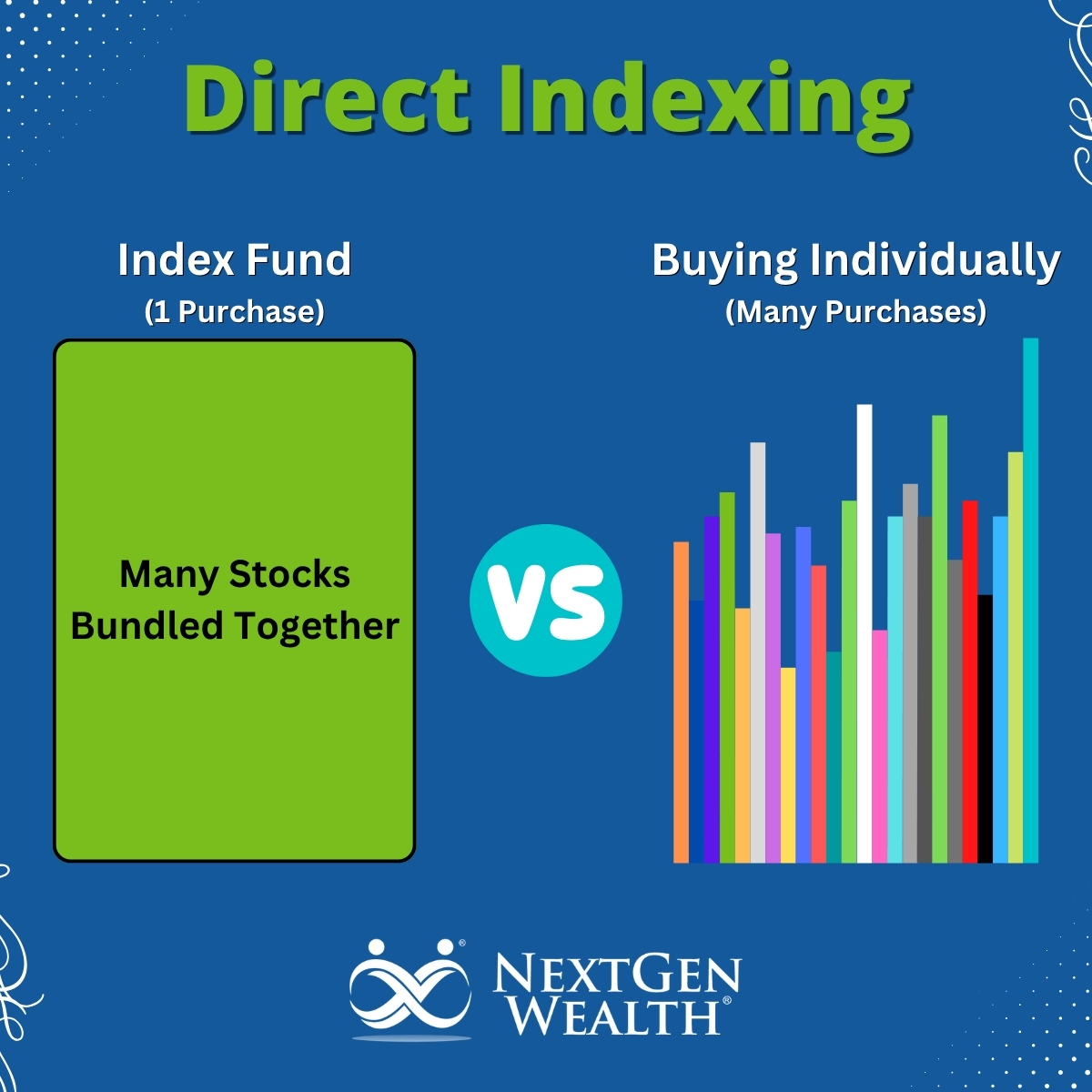
Direct indexing differs from buying an index fund, mutual fund, or exchange-traded fund (ETF) because you hold individual stocks. In contrast, an index fund or ETF tracks an index and holds individual stocks, and you buy a share of that fund or ETF.
Using an index fund lets you track the index's performance without buying all the individual shares. You’d purchase shares of one fund, not hundreds of individual stocks. The disadvantage is paying a (usually) small fee to the company that offers the index fund, and you can’t sell individual holdings within the fund or ETF.
Why Investors Are Hearing More About It
There are probably a few reasons why direct indexing seems more common these days. First, we’ve leveraged technology to become very efficient at trading, tracking, and researching stocks. Second, participation in the stock market has grown significantly. The result is that many people have the ability and interest to create greater tax efficiency.
There’s also probably some complexity bias happening as well. Simply buying index funds and waiting seems too simple and boring. In reality, it often doesn’t take much to have a diversified portfolio.
Most importantly, the competitive landscape of investment managers creates niche opportunities for direct indexing specialization. It’s not a strategy for everyone. Plus, boring and stable is often the better option for retirees seeking a steady income.
When Direct Indexing May or May Not Be Worth Considering
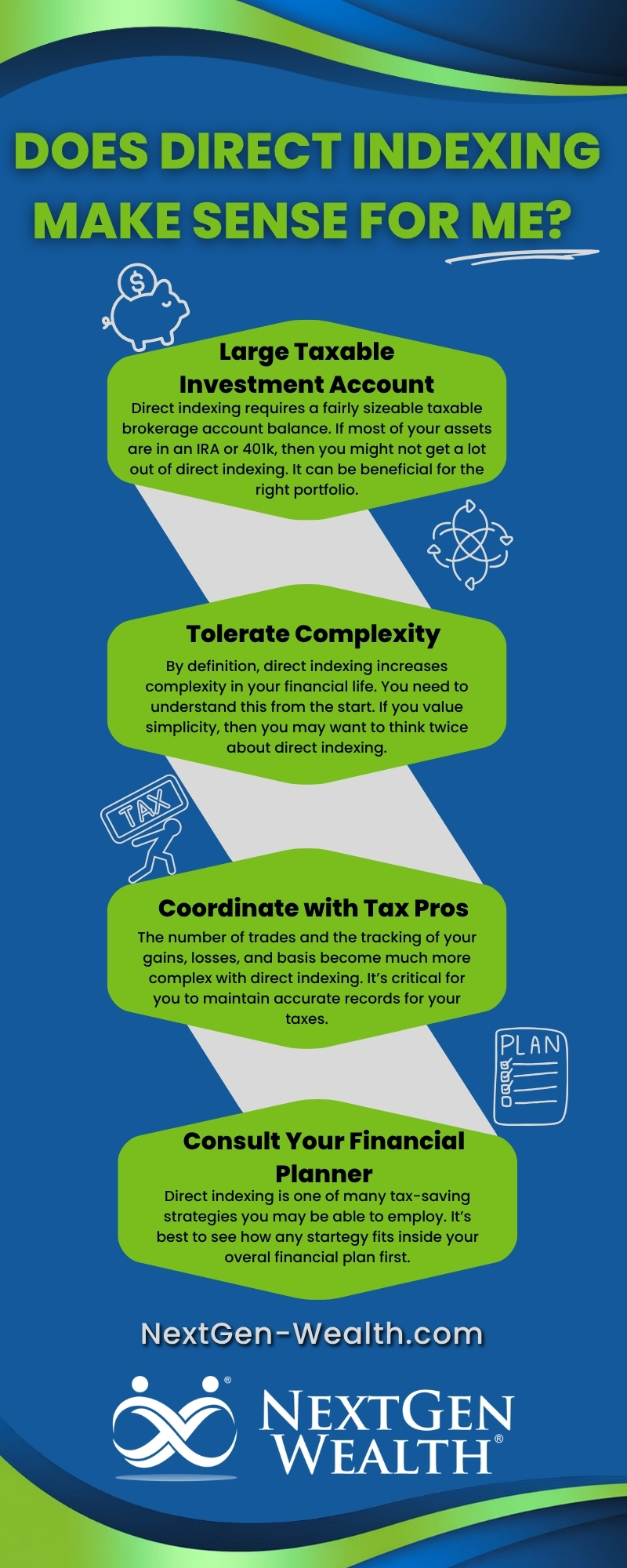
Direct indexing only works well when you have a large taxable investment account balance. If most of your money is in your IRA or 401k, direct indexing might not be particularly useful. The total costs of buying individual shares of all the stocks in an index can make it difficult for smaller accounts.
For example, if you wanted to purchase one share of each of the 503 stocks included in the S&P 500®, you’d need roughly $118,328 (prices as of 7/18/2026). But to get the weighting (how much of each to buy), you’d need much more.
In practice, direct indexing isn’t usually possible with less than about $500,000 or more. Even then, it may not be worth the added complexity, cost, and accounting until you’ve got $1 Million or more in taxable accounts. There’s software to help make direct indexing easier at lower investment levels, but it’s still adding costs and complexity.
Using Fractional Shares for Direct Indexing
In recent years, the emergence of fractional shares has made direct indexing possible with much less money. However, this still requires a significant amount of dough to have a meaningful impact on your taxes.
Why Direct Indexing May Appeal to Retirees
Even with the added complexity and costs in time and money, many retirees may still be interested in direct indexing. This is a personal decision you should weigh carefully.
Tax-Loss Harvesting Opportunities
Some retirees may have large required minimum distributions (RMDs) they need to offset for tax purposes. You might have concentrated stock positions from your former employer. Realizing some market losses can offset gains from selling those concentrated positions.
Direct indexing can also be helpful during large market swings, down markets, and recessions. When one sector is down, you can trade within one sector, realize losses, but still take advantage of the recovery. This can help you pay taxes at a lower rate.
Greater Portfolio Customization
In some cases, stock holdings may be particularly important. For instance, you may have been gifted or inherited a particular stock from an admired friend or family member. This can be a sensitive subject when selling holdings with sentimental value.
Direct indexing can be helpful for managing concentrated stock positions or legacy holdings like this. It allows investors to maintain a concentrated holding while reducing other holdings with similar characteristics or risks. The result is a custom portfolio that isn’t too overweight because of a stock you’re not willing to let go of.
To be clear, holding a substantial portion of your investment in one stock usually isn’t the preferred option. However, there’s more to life and retirement than money. Optimal by the numbers might not always be the most optimal for your happiness.
Tax Planning Considerations in Retirement
Direct indexing should be a part of a broader tax planning strategy. Once you’ve accumulated everything you need for retirement, one of the biggest remaining issues is tax mitigation. Taxes are often a large expense in retirement.
Coordinating Direct Indexing with Retirement Income Withdrawals
One thing you absolutely need to pay attention to is your capital gains and regular taxable income from IRA or 401k withdrawals. When you combine your capital gains with regular withdrawals, you can push yourself into higher income tax brackets. This can have some unintended consequences.
You’ll need to carefully manage other capital gains, dividends, and inherited accounts too. All of these have slightly different taxation rules, but they all raise your total taxable income and various modified adjusted gross income (MAGI) calculations. For instance, an increased MAGI for your Medicare income-related monthly adjustment amounts (IRMAA) could raise your monthly Medicare premiums.
Charitable Giving and Legacy Planning Opportunities
Your charitable giving should also be coordinated with your direct indexing efforts. In some cases, you can use charitable giving to offset some of your gains from placing trades and realizing gains. You may also want to use a qualified charitable distribution (QCD) to avoid some or all of your required minimum distributions (RMDs).
Are you checking or reviewing your retirement portfolio? This checklist shows you the difference.
Potential Drawbacks and Risks
Although direct indexing offers potential benefits, it also has drawbacks. Coordinate with your accountant and financial planner before implementing a direct indexing strategy. If you miss key tax details, you could create many more headaches and costs.
Complexity Compared to Traditional Funds
One of the biggest drawbacks of direct indexing is complexity. When you’re managing dozens or hundreds of holdings, there’s a lot more to keep track of. This is much more complex than a portfolio of mutual funds, index funds, and bond funds.
Costs, Account Minimums, and Ongoing Management
In most cases, you’ll need to use direct indexing software, a professional who specializes in direct indexing, or both. All of these add costs, diminishing the usefulness of direct indexing. Regardless, there’s no truly passive way to implement direct indexing.
As we mentioned, you need a large taxable balance to even have enough money to implement a direct indexing strategy. Fractional shares can help, but you’re relying on the custodian to offer this option. You may also incur additional costs for using fractional shares.
When Simpler Investment Strategies May Be Better
For most retirees, direct indexing isn’t going to be a game changer. If most of your retirement funds are in an IRA or 401k, direct indexing just isn’t going to move the needle much. Most retirees are primarily focused on making sure they have adequate income to last throughout retirement.
The number of trades necessary can also create tons of additional documentation requirements for filing your taxes. This adds complexity, which most people don’t like when it comes to taxes. Taxes are complicated enough!
How a Financial Planner Can Help You Decide
It’s best to consult with a financial planner who’s familiar with direct indexing. This is a common term, but very few financial professionals specialize in this strategy. For most people, it just doesn't apply, so most pros don’t spend much time on it.
A good financial planner can help you evaluate whether direct indexing fits your retirement plan. Along with direct indexing, they can help with coordinating investments, taxes, retirement income, and estate planning.
Asking the Right Questions Before Making a Change
You always want to ask the important questions up front. These may include:
- What are your thoughts on direct indexing?
- What costs are associated with implementing a direct indexing strategy?
- What alternatives are there to direct indexing?
- What’s your overall tax planning strategy and process?
Bottom line, make sure you’re keeping an open mind. The answer may very well be something other than direct indexing for you. You may find other tax-saving strategies to be easier, simpler, and more effective for your situation.
How NextGen Wealth Can Help
At NextGen Wealth, we start by helping you define what really matters most. Then, we’ll help you craft a plan to achieve as many of your goals as possible. We’re not dead set on any one strategy or method of reducing taxes.
The most important thing to us is to ensure you enjoy your retirement without worrying about finances. In fact, Clint’s book, Retirement the Right Way, was born from the person-centric planning we do at NextGen Wealth. Contact us today to schedule your no-obligation financial assessment and see if we’re a good fit to work together.
 This article was written by