How Much of My Social Security is Taxed?

Social Security taxation can be as confusing as it is complicated. As one of the oldest and most critical retirement benefits, Social Security definitely deserves your attention. You also don’t want your Social Security to increase your tax bill.
Your Social Security strategy directly affects your taxes. It’s important to understand the when, why, and how of Social Security taxation.
Table of Contents
- Understanding How Social Security Benefits Are Taxed
- Why Up to 85% of Your Benefits May Be Taxable
- How Combined Income Determines What You Owe
- Simplified Example of Calculating Taxable Social Security Benefits
- Other Retirement Income That Can Increase Your Tax Bill
- Strategies for Reducing Taxes on Social Security
- How NextGen Wealth Helps with Social Security
Understanding How Social Security Benefits Are Taxed
Let’s start by saying we don’t necessarily agree with taxing Social Security. However, we can't do anything about it, so we prefer to focus on what we can control. If you’re really interested in the long history and explanation of why Social Security is taxed, you might find this article from the Social Security Administration interesting.
Regardless, current laws and IRS rules could make a portion of your Social Security taxable. Some states also tax your Social Security income, but many only tax a portion. Missouri generally doesn’t tax Social Security benefits if they're included in your federal adjusted gross income, and Kansas has an exemption under a certain income level, or only a portion of your Social Security is taxable.
Differences Between Your Taxable Benefits and Your Tax Rate
It’s important to understand the difference between the amount of your taxable Social Security benefits and your individual tax rate. Your taxable Social Security is calculated using the Social Security Benefits Worksheet contained in the “Instructions for Form 1040” from the IRS.
The worksheet combines several of your income sources, adds 50% of your Social Security benefits, and then determines if 0%, 50%, or up to 85% of your benefits are taxed. Once this taxable amount is determined, it’s entered into the calculation for your Adjusted Gross Income (AGI), which is then used to calculate your taxable income.
A Quick Note on the IRS Distinction Between AGI and Taxable Income
Understanding the difference between your AGI and taxable income matters. Your AGI is used to determine your taxable income. Your AGI includes all your income, adjusted for deductions such as business expenses, capital losses, or other allowable deductions.
Your taxable income is your AGI minus any other deductions such as the standard deduction, including the “enhanced” senior deduction (from Schedule 1-A). The graduated income tax rates are then applied to your taxable income.
Why Up to 85% of Your Benefits May Be Taxable
In short, the taxable portion of your Social Security is derived from the estimated portion of the average employee’s direct contributions to their benefits. In plain language, 15% of your Social Security payments are considered a return of the Social Security (FICA) taxes you’ve paid toward your own benefit.
This came about because the Old-Age and Survivors Insurance Trust Fund (OASDI) was projected to run out of money by 1983. A National Commission on Social Security Reform was formed, and it recommended treating Social Security more like a private pension. The “Greenspan Commission” recommended taxing the portion not funded by direct employee contributions.
Tiered Taxation Thresholds of 50% and 85%
Ultimately, the idea of making 50% of Social Security taxable stuck, but it was modified with thresholds, taxing 85% of Social Security for “higher income” earners. Keep in mind, the thresholds haven’t been indexed for inflation, so the thresholds of $25,000 (single) and $32,000 (married) were vastly different in 1984.
If those amounts had been adjusted for inflation, it might be roughly $82,000 ($81,922.96 based on CPI calculations) and $105,000 ($104,861.39 based on CPI).
When 85% of Your Benefit Becomes Taxable
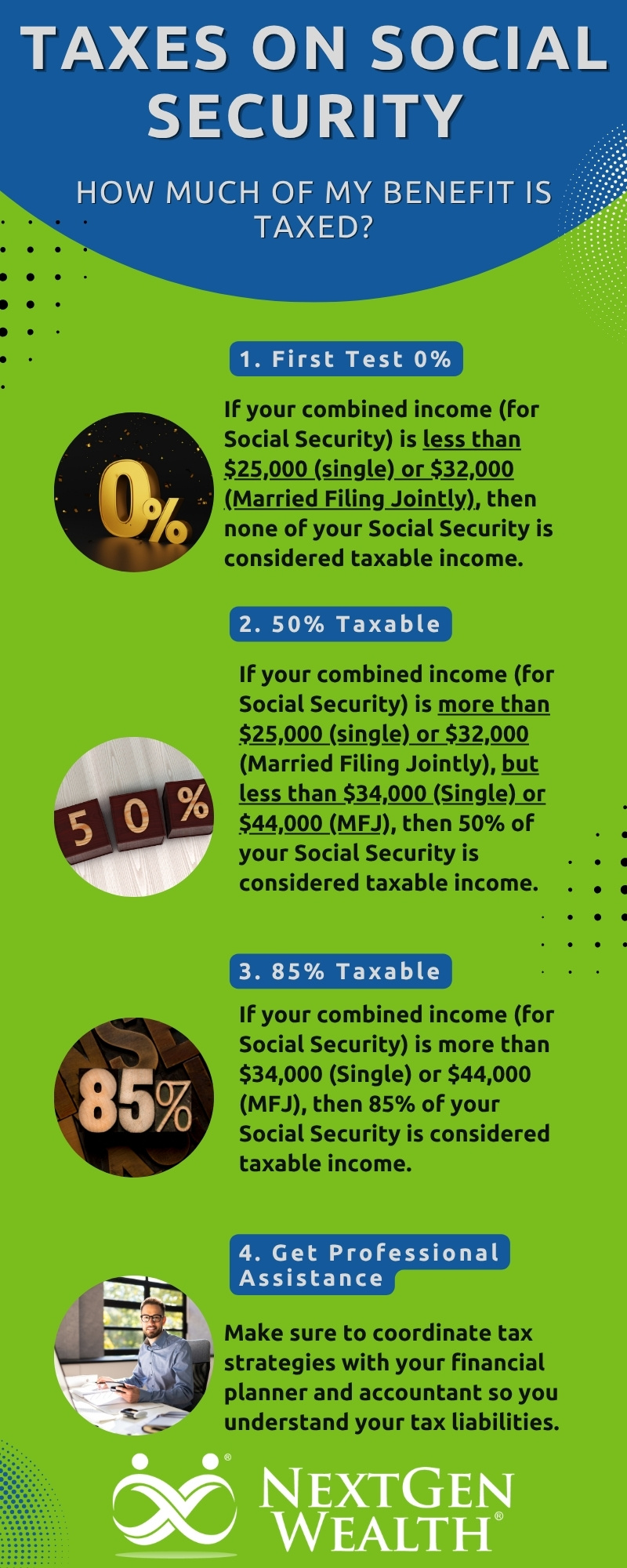
If your combined income reaches $34,000 (single) or $44,000 (Married Filing Jointly), then up to 85% of your Social Security benefits are taxable. This is all calculated using the Social Security Benefits Worksheet (see the Form 1040 instructions).
When Social Security Benefits Are Not Taxable
If your combined income is less than $25,000 (single) or $32,000 (MFJ), then none of your Social Security retirement benefits are taxed.
How Combined Income Determines What You Owe
To determine how much of your Social Security income is taxed, the IRS calculates your “combined income” on the Social Security benefits worksheet. This isn’t necessarily a technical term, but it’s helpful to know this number differs from your AGI or taxable income.
What Is Included in the Combined Income Calculation?
Your “combined income” for Social Security taxation includes many components of your adjusted gross income, but not the adjustments from Schedule 1 (deductions). It also adds in any tax-exempt interest. Without getting overly complicated, it’s all income, almost none of the deductions, 50% of your Social Security income (possibly all of it), and any tax-free interest.
In other words, it’s looking at all “useable” money at your disposal during the tax year.
Income Thresholds for Single and Married Taxpayers
There are three separate thresholds for Social Security taxation: none (0%), 50% of benefits, or 85% of benefits. If your combined income is less than $32,000 ($25,000 single filers), then none of your Social Security is taxed. If you earn more, the Social Security benefits worksheet uses two separate calculations to determine how much of your Social Security is taxable, between 50% and 85%.
One exception is for married filing separately. If you are filing married filing separately and lived with your spouse at any time in the year (even one day), then 85% of your Social Security is taxable income. Your income threshold becomes $0.
Taxable Social Security vs Taxable Income
A final and particularly important distinction is the difference between taxable Social Security and taxable income. Even if the maximum Social Security becomes taxable, you might not actually pay taxes on it. Your taxable Social Security becomes a part of your AGI.
Then your AGI determines your taxable income. If you have enough credits and deductions, you might not pay any taxes on Social Security at all. If this seems confusing, that’s because it is.
Temporary Reduction from Current Law
In fact, this is the mechanism by which the One Big Beautiful Bill Act (OBBBA) made Social Security “tax-free” for most seniors. The higher standard deduction in concert with the “enhanced” senior deduction makes the taxable portion of Social Security deductible by default. It’s essentially a tax-deduction shell game, but the result is that most seniors will have standard deductions equal to the average Social Security benefits received.
Before the OBBBA, roughly 64% of seniors owed no tax on Social Security. During the OBBBA “enhanced” deduction phase (tax years 2025 through 2028), an estimated 88% of seniors will have exemptions and deductions that exceed taxable Social Security income.
Simplified Example of Calculating Taxable Social Security Benefits
Let’s use our good friends Max and Minny Benny as an example. If both are receiving Social Security, taxation of benefits is much more likely. We’ll use the average monthly Social Security payment of $2,071 for 2026, totaling $49,704 as a couple.
Right away, we’re close to the first threshold of $32,000 (using half their Social Security benefits). Max and Minny have to withdraw an additional $3,000 per month to cover their living and travel expenses. This adds $36,000 of income from IRA withdrawals.
This is enough to make 85% of their Social Security taxable. Now they have an AGI of roughly $78,248 from a total of $85,704 of useable income.
Calculating Max and Minny’s Taxable Income
With the standard deduction of $32,200, plus the “normal” additional age 65 standard deduction of $1,650 each, and the new “enhanced” senior deduction from the One Big Beautiful Bill Act of $6,000 each, they have a combined standard deduction of $47,500 for 2026. This significantly reduces their taxable income to $30,748, which is less than their total Social Security benefits alone.
This would translate to roughly $3,194 in total federal taxes (unless they qualify for additional credits or deductions).
Note: This is an extremely simplified version of what goes into your taxes each year. Just completing the Social Security Benefits Worksheet is enough to make your head hurt. We didn’t include common forms of additional income such as interest income, dividends, pension income, or capital gains.
Most people’s tax returns are a tad more complicated. That is why we suggest working with a tax professional to make sure everything is done properly.
Other Retirement Income That Can Increase Your Tax Bill
Although Social Security is often a major source of income for retirees, it’s only one part of the equation. Other streams of retirement income can have a much larger impact on your taxes, including increasing your total taxable Social Security.
Pension, 401(k), and Traditional IRA Withdrawals
Income from pensions, employer plans like a 401k or 457, or traditional (tax-deferred) IRA withdrawals can have a major impact. This is especially true if you’re subject to required minimum distributions (RMDs). With RMDs, you don’t have as much control over your income.
Investment Income and Tax-Exempt Interest
We’ve all seen the commercials for various forms of “tax-free” income like municipal bonds. These income sources are added back into the equation for Social Security taxation. This can act as a sort of “phantom tax” on these income-producing assets.
Also, the after-tax yield of things like tax-free bonds is often lower than taxable bonds. Bond prices generally adjust for the allure of “tax-free” or “tax-advantaged” products.
How Roth Withdrawals Can Help Manage Taxable Income
On the other hand, withdrawals from your Roth IRA aren’t included in your AGI or Social Security Benefits Worksheet. This makes Roth accounts immensely helpful in retirement.
Strategies for Reducing Taxes on Social Security
If you start planning now, you may be able to save yourself on taxes (and the resulting headaches). There are more than a few ways to maximize the tax efficiency of your Social Security income.
Coordinate Retirement-Account Withdrawals Before and After Claiming
It can often be beneficial to delay claiming Social Security. This isn’t just because of the additional delayed retirement credits. There’s also more to it than just extracting the most money from Social Security.
Beyond not knowing how long we’ll live, it’s hard to predict how tax laws may change in the future, too. The only true way to “game the system” is by outliving the actuarial tables and drawing a few “extra” years. Statistically speaking, most of us don’t.
It’s better to focus on what we can control first, while trying to influence things like health and longevity.
Consider Roth Conversions Before Required Minimum Distributions
You can often create tax-saving opportunities by coordinating when you stop working and when you start drawing Social Security. If you can wait to draw until full retirement age or later to age 70, you can create an artificial “dip” in income to complete tax-efficient Roth conversions.
You’ll still need to watch for other pitfalls like IRMAA surcharges, but Roth conversions can be extremely helpful. Even if you convert only a portion of your overall balance, you can create flexibility and opportunities to lower your RMDs and tax bill.
Build a Tax-Efficient Retirement Income Plan
Understanding the basics of how Social Security is taxed is essential to building a tax-efficient retirement plan. This can be a real benefit to a safe, secure, and happy retirement. But it all starts with what you truly want.
This seems easy to figure out, but it gets much harder once we start layering in limitations like health, family commitments, and other factors. If you’re married, you add the extra layer of “our” wishes and goals (yours, mine, and ours, right?).
How NextGen Wealth Helps with Social Security
Social Security is one of the biggest pieces of American retirement planning. You don’t want to take this irrevocable decision lightly. Make sure you clearly understand the impact on your retirement.
At NextGen Wealth, we specialize in the critical decisions around the start of your retirement. We walk our clients through our COLLAB Financial Planning Process™ to make sure we cover all the important details of your retirement. Contact us today to schedule your no-obligation financial assessment to see if we’re a good fit to work together.
 This article was written by