Is Social Security Tax-Free in Kansas City?

Kansas City is one of the best places to retire. But how is Social Security taxed at the state and local level? Taxes are a major consideration for retirees, so you want to ensure you make the right decisions.
Whether you’re on the Kansas side or Missouri side, state tax laws affect you. We might share a love of the same sports teams (go Chiefs!), but taxes can be different across state lines.
Table of Contents
The State Tax Picture in Missouri and Kansas
Depending on which side of the state line you’re on, taxation rules may vary. And rules about Social Security taxation have changed within the last couple of years, so it’s always worth rechecking things periodically. However, both Missouri and Kansas operate very similarly when it comes to taxing Social Security benefits.
Missouri’s Social Security Deduction and Eligibility Rules
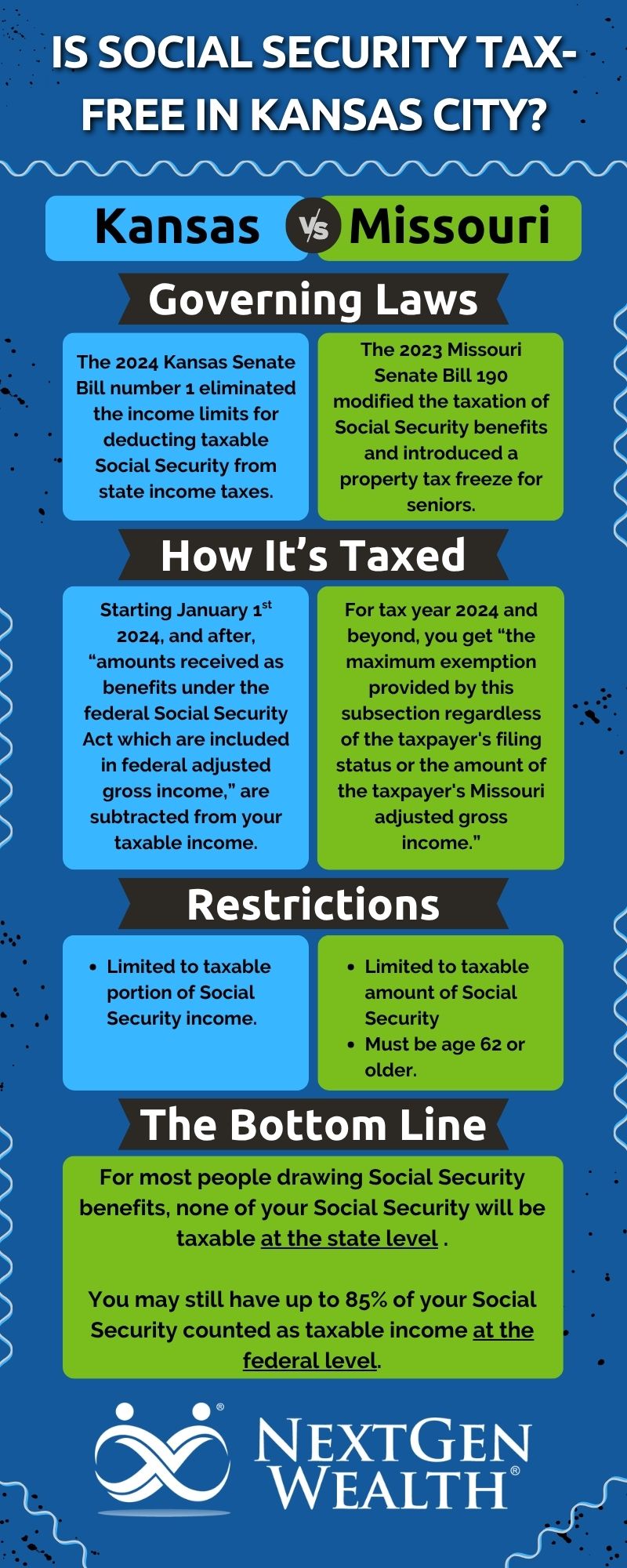
The 2023 Missouri Senate Bill 190 (often called SB 190) modified the taxation of Social Security benefits and introduced a property tax freeze for seniors. For tax year 2024 and beyond, it says you’re “entitled to the maximum exemption provided by this subsection regardless of the taxpayer's filing status or the amount of the taxpayer's Missouri adjusted gross income.”
In other words, if you’re receiving Social Security retirement benefits, you’ll have a deduction up to the taxable amount reported on your federal tax return. This includes payments from Social Security Disability Income (SSDI). However, the age limitation of over 62 would exclude payments for survivorship benefits.
Kansas’s Social Security Tax Exemption
The 2024 Kansas Senate Bill number 1 (referred to as SB1), eliminated the income limits for deducting taxable Social Security from state income taxes. For tax years starting on January 1st 2024, and after, “amounts received as benefits under the federal Social Security Act which are included in federal adjusted gross income,” are subtracted from your taxable income.
In other words, whatever portion of your Social Security benefits is included in your federal income tax will be included on your state return, but later deducted from your income. It seems like a roundabout way of excluding your Social Security from your income, but our guess is this prevents folks from deducting more than what would have been taxed to begin with. At most, 85% of your Social Security will ever be subject to taxation.
You can learn more on the Kansas Department of Revenue frequently asked questions page.
How Federal Taxes Affect Your Social Security Benefits
Both Missouri and Kansas base their exemption on the amount of your Social Security included as income on your federal tax return. So the next logical question is, how much of your Social Security is taxable in the first place? In short, somewhere between 0% and 85 % of your Social Security may be taxable.
Determining How Much of Your Social Security is Taxable
In true fashion, the federal laws are complicated. We feel the IRS does a pretty good job of clarifying, though. There’s a frequently asked questions page on the IRS website with information, as well as an interactive tool to help you understand how much of your Social Security benefits are taxable at the federal level.
We also wrote an entire article on determining how much of your Social Security is taxable. However, if your combined income (half of Social Security plus all other income) is above $44,000 for married filing jointly or $34,000 for single filing (2026 numbers), just assume that 85% of your Social Security will be considered taxable income. This isn’t a direct reduction of benefits; it makes a portion of your Social Security check subject to taxes.
How Other Retirement Income Affects Your Taxable Benefits
Most retirees have more tax-planning opportunities they should take advantage of before worrying about how much of their Social Security benefits will be taxed. In fact, managing your broader tax situation could lower your overall effective tax rate and reduce the impact of taxable Social Security income.
What the Senior Tax Deduction Means for Your Tax Bill
One temporary piece of tax relief for retirees is the new “enhanced” senior deduction. In short, it allows for an additional $6,000 annual deduction for taxpayers age 65 and older. In effect, this makes most retired Americans’ standard deduction larger than their Social Security income.
Although this isn’t technically making your Social Security tax-free, the total taxes paid are similar.
Coordinating Social Security with Retirement Account Withdrawals
It’s easy to get wrapped up in all the tax rules, but we need to always come back to the most important number: how much income do you need each month to live comfortably? None of this complicated, whiz-bang tax-planning matters when you’re at the gas pump or in the checkout line at the grocery store or the pharmacy. We always want to start and end by providing stable, predictable retirement income.
In other words, we suggest starting by clarifying your needs, then working back from there. In most cases, we can adjust the timing of withdrawals and when you claim Social Security to lower your overall tax burden. If you’re looking at a long-term tax issue like high required minimum distributions, then we can add strategies like Roth conversions.
Weighing Roth Conversions Before and After Claiming Benefits
Roth conversions are typically a strategy we employ before claiming Social Security, and sometimes through your early to mid-70s when RMDs begin. However, the general trend is to delay claiming Social Security until full retirement age (FRA) or even longer. This increases your monthly benefit amount and reduces your overall taxable income while converting to Roth.
Every situation is different, so this “window” for optimal Roth conversions will vary from person to person. The idea is to temporarily reduce taxable income so you can convert your IRA to Roth at a lower overall tax rate. Just make sure you’re carefully managing withholding and estimated tax payments so you don’t get a surprise tax bill.
How NextGen Wealth Can Help
We’re lifelong KC fans and really believe it’s a fantastic place to grow up, raise a family, and retire. We also have decades of experience helping folks transition into retirement. Our COLLAB Financial Planning Process™ is designed to help you organize your financial life around what matters most.
Tax planning is an integral part of the planning we do for clients. Taxes touch every aspect of our lives, but they don’t need to control our lives either. Contact us today to schedule your no-obligation financial assessment to see if we’re a good fit to work together.
 This article was written by